Automate Your Crypto Trading and Build Passive Income
Is JonnyBlockchain Safe and Non-Custodial? (Full 2026 Breakdown)
When I started exploring crypto automation, the first question I asked myself wasn't "How much profit can I make?" It was "Is my money actually safe?" That's a smart question to ask, and I appreciate you asking it too.
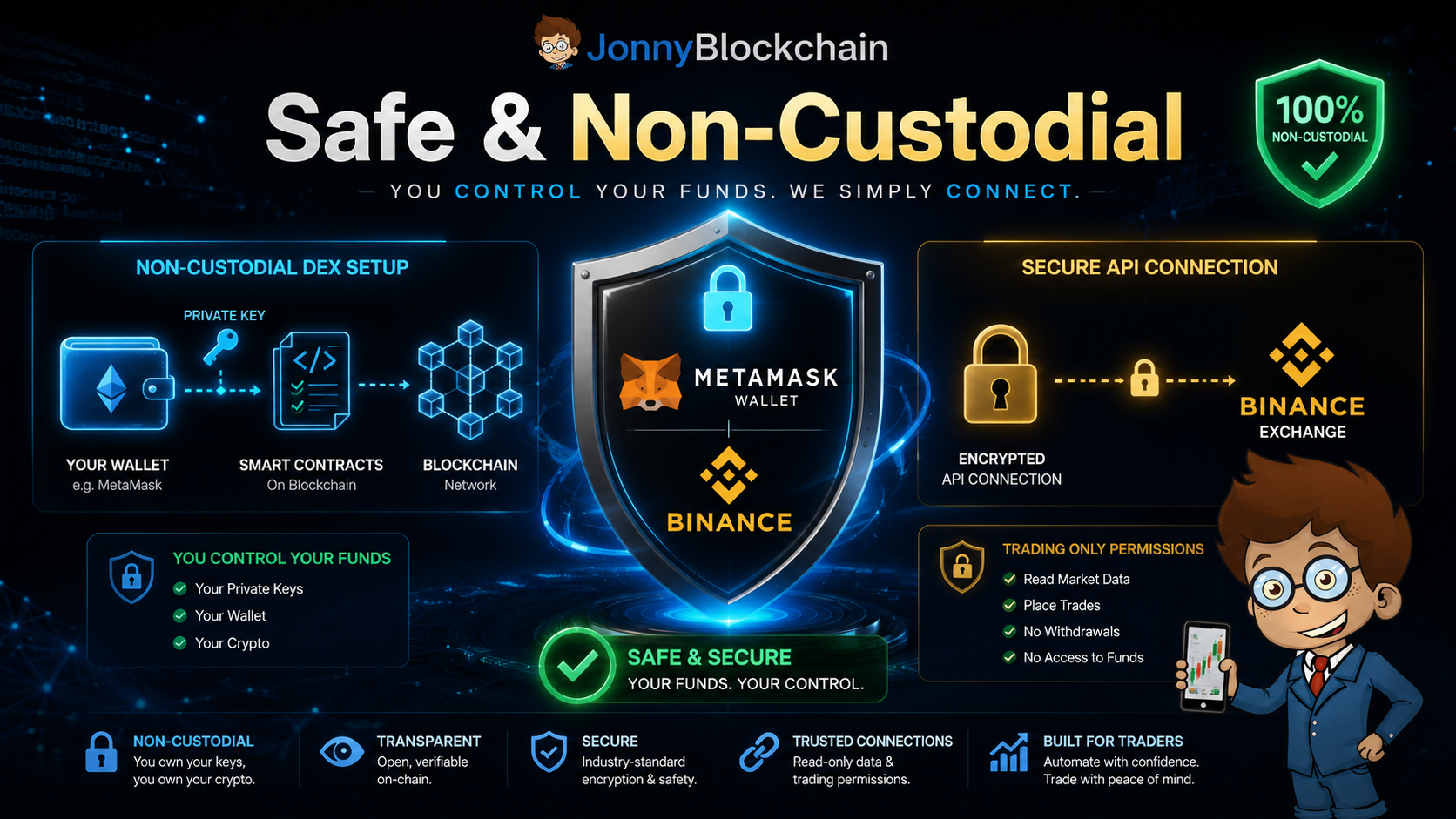
The short answer is yes, JonnyBlockchain is non-custodial—but that word means different things depending on whether you're trading on decentralized exchanges (DEX) or centralized exchanges (CEX). Let me break down exactly what non-custodial means, where your funds actually are, and what risks you should genuinely understand before you start automating your trading strategy.
What Does "Non-Custodial" Actually Mean?
Non-custodial means the platform doesn't hold your funds. You do. Your private keys, your wallet, your responsibility. It's the opposite of custodial platforms where you hand over your crypto to a company and trust them to keep it safe (like depositing money in a bank).
But here's where it gets nuanced: non-custodial doesn't mean "no risk." It means you retain control. That's actually empowering, but it also means you need to set things up correctly.
Let me walk you through how this works on JonnyBlockchain, because the security model is genuinely different depending on which type of trading you're doing.
DEX Trading: Fully Non-Custodial and Private-Key Controlled
How DEX Trading Works (BSC and BASE Blockchains)
When you use JonnyBlockchain for decentralized exchange (DEX) trading on Binance Smart Chain or BASE, here's what happens:
- You connect your MetaMask wallet to the platform
- You keep your private keys in MetaMask—JonnyBlockchain never knows them
- The bot trades directly via smart contracts deployed on the blockchain
- All transactions are on-chain and verifiable
- JonnyBlockchain never touches, holds, or can access your funds
This is true non-custodial trading. Your MetaMask wallet is your bank account. I keep my private key backed up offline, stored safely. JonnyBlockchain can't freeze my funds, can't access them, and can't disappear with them. The bot only has permission to execute trades that I've approved.
You'll need to keep a small amount of BNB or ETH in the wallet for gas fees (usually around 0.04 BNB, which is roughly $12–15 at current prices), but that's just operational necessity, not a custody risk.
The "Not Your Keys, Not Your Crypto" Principle
If you're using DEX trading on JonnyBlockchain, this principle works in your favor. You own your keys. You own your crypto. Nobody—not JonnyBlockchain, not a government, not a hacker with access to the platform—can take your funds without your private key.
CEX Trading: Non-Custodial From JonnyBlockchain's Perspective
How Binance API Integration Works
When you set up a bot on Binance, the security model is different, but still non-custodial from JonnyBlockchain's side:
- Your crypto stays in your Binance account—JonnyBlockchain doesn't hold it
- You generate API keys in your Binance account that give permission for specific actions
- JonnyBlockchain uses these keys to place trades on your behalf
- Binance is the custodian (you trust Binance, not JonnyBlockchain)
Here's what's important: you can restrict your API keys to trading only. This means the bot can place orders, but it cannot withdraw your funds, change your password, or access your email-linked features. That's a crucial security layer.
I always recommend setting API key restrictions when you're automating trading on a CEX. It's in Binance's settings and takes five minutes to set up properly.
DEX vs CEX: A Quick Comparison
| Factor | DEX (BSC/BASE) | CEX (Binance) |
|---|---|---|
| Custody Model | You hold keys (MetaMask) | Binance holds funds |
| Who Controls Your Funds? | Only you (with your private key) | Binance (you trust the exchange) |
| JonnyBlockchain Access | Zero access to funds (only trades) | API-only, trading permissions only |
| Risk if Platform Hacked | Your funds stay safe | Binance custody risk (not JB's fault) |
| Risk if Bot Malfunctions | Bot can lose money, but can't steal | Bot can lose money, but can't steal |
| Setup Complexity | Medium (MetaMask + wallet funding) | Medium (API keys + restrictions) |
Real Risks You Should Honestly Understand
Smart Contract Risk
DEX trading runs on smart contracts. Smart contracts can have bugs. If there's a vulnerability in the code, it theoretically could be exploited. This is why reputable platforms get code audits. I recommend checking JonnyBlockchain's documentation for any third-party audits of their smart contracts.
That said, millions of dollars flow through DEX trading every single day. The ecosystem is battle-tested. But it's not zero-risk.
API Key Security
If you're using Binance CEX trading, your API keys are sensitive. If someone gets those keys, they could trade with your funds. Here's how to protect yourself:
- Use API key IP whitelisting (restrict access to your computer's IP)
- Enable "Restrict to trading only" permissions
- Never share your API keys with anyone
- Regenerate keys if you suspect compromise
- Don't store keys in plaintext files
Trading Risk (The Big One)
Here's the honest truth: bots can lose money. Being non-custodial doesn't protect you from bad trades. If your bot is programmed to buy high or if market conditions move against your strategy, you will experience losses. That's not a custody issue—that's trading risk.
Automation doesn't mean guaranteed profits. It means consistent execution of your strategy, whatever the results.
Safety Best Practices for Using JonnyBlockchain
Before You Start
- Start with a small amount of capital to test your bot and strategy
- Paper trade or backtest your settings first if available
- Watch the setup tutorials on JonnyBlockchain's user guide
- Understand your bot settings completely before going live
For DEX Trading
- Use a dedicated MetaMask wallet (separate from your main holding wallet if possible)
- Back up your seed phrase offline and store it securely
- Keep only necessary funds in the trading wallet
- Verify you're connecting to the real JonnyBlockchain site (check the URL)
For CEX Trading
- Generate separate API keys for JonnyBlockchain (don't reuse keys from other bots)
- Always enable IP whitelisting
- Always restrict to trading only (disable withdrawal permissions)
- Use Binance 2FA (Google Authenticator or SMS)
- Monitor your API key activity in Binance settings regularly
General Practices
- Monitor your bots regularly—don't set and forget
- Review bot performance weekly and adjust if needed
- Keep your computer and passwords secure
- Use strong, unique passwords for your JonnyBlockchain account
So, Is JonnyBlockchain Safe?
Yes, if you understand what safety means. Non-custodial architecture is a genuine security advantage. The platform doesn't hold your funds, which is good design. On DEX, you keep absolute control. On CEX, you're trusting Binance (a major, regulated exchange), not JonnyBlockchain.
But safety isn't just about custody. It's about setup, discipline, and honest expectations. A well-set-up bot with proper permissions and monitoring is genuinely safe. A bot run by someone who skips security steps or ignores losses is more risky.
The non-custodial model means you're responsible for your security, and you're in control. That's powerful. Use that power wisely.
Frequently Asked Questions
Can JonnyBlockchain access my wallet if I use DEX trading?
No. When you connect MetaMask, JonnyBlockchain gets permission only to execute transactions you've approved. It cannot access your private key, withdraw funds without your signature, or do anything outside the scope you've authorized.
What happens if JonnyBlockchain gets hacked?
On DEX: Your funds are completely safe because they're in your MetaMask wallet on the blockchain. JonnyBlockchain doesn't hold them.
On CEX: Your funds are in Binance's custody, not JonnyBlockchain's. Your risk is with Binance's security, not JonnyBlockchain's.
Is it safe to share my API keys with JonnyBlockchain?
Yes, if you've restricted them properly. Use Binance's API key restrictions to disable withdrawal permissions and whitelist your IP. That way, the worst that could happen (if JonnyBlockchain or a hacker somehow got the key) is unauthorized trading, not fund theft.
What if my bot makes losing trades? Can I get a refund?
No. Losses are part of trading risk. The bot executes your settings correctly—it's not responsible if your strategy doesn't profit. This is why starting small and backtesting matters.
Do I need to give JonnyBlockchain permission to withdraw my funds?
You should never do this. Always use API keys restricted to trading only. JonnyBlockchain doesn't need withdrawal permission to function, and giving it away increases risk unnecessarily.
Is DEX trading safer than CEX trading?
Different risk models. DEX is safer in terms of custody (you hold keys) but has smart contract risk. CEX is safer in terms of trading infrastructure (Binance is reliable) but depends on Binance's custody practices. Both are legitimate when set up properly.
What's the minimum I should keep in my DEX fee wallet?
About 0.04 BNB or equivalent ETH for BASE. This covers gas fees for multiple trading transactions. Keep it small—you don't want to hold too much in a hot wallet.
Can I use JonnyBlockchain from multiple devices?
For DEX: Yes, as long as you're using the same MetaMask wallet connected to the site. For CEX: Yes, though API key IP whitelisting might require you to add multiple IPs if you're trading from different locations.
Getting Started Safely
If you're ready to try automated trading, here's my recommendation: start with a very small amount ($50–100), run it for a week, and really understand how your bot performs before scaling up. Read JonnyBlockchain's user guide tutorials. Set up your security properly. Monitor your positions.
Non-custodial automation is genuinely secure when you handle your side of the equation. The platform has done its job by not holding your funds. Now it's up to you to protect your keys, restrict your API permissions, and trade with intention.
That combination—good platform design plus user responsibility—is how safe automation actually works in crypto.
Ready to start earning passive income with crypto automation?
Join thousands of members using JonnyBlockchain trading bots to automate their crypto strategy.
👉 Get Started at JonnyBlockchain.com